
Architectural Technical Debt: How Software Coupling Drives Cost, Risk, and Slower Change


Architectural Technical Debt: How Software Coupling Drives Cost, Risk, and Slower Change
Executive summary
Architectural technical debt is the future cost and risk created when a software system’s structure makes it difficult to change safely. One of its most important drivers is coupling: the degree to which components depend on one another.
When coupling is high, a change in one area of a system can affect many others. This increases coordination, testing, defect risk, maintenance effort, and the time required to deliver new capabilities.
Research examining two large, mature software systems found that highly coupled components generated a disproportionate share of defect-related maintenance work. In one system, core components represented roughly 26% of files but accounted for 62% of defect-related activity.
For technology leaders, the implication is clear: modernization should not begin as a broad mandate to “reduce technical debt.” It should begin with an objective understanding of where architectural dependencies create the greatest operational and business impact.
Key takeaways
- Architectural technical debt is not just a code-quality problem, it is a business risk created when system dependencies make change slower, costlier, and less predictable.
- Research shows that a relatively small group of highly coupled components can generate a disproportionate share of defect-related maintenance work.
- The most effective modernization programs use architectural data to prioritize targeted, incremental refactoring—not broad, disruptive rewrites.
- As AI accelerates code creation, architectural visibility becomes more important: organizations need to know whether faster delivery is improving or degrading long-term system health.
What is architectural technical debt?
Technical debt is created when a decision that is expedient today increases the cost of maintaining or adapting a system later.
It can take many forms: inadequate testing, missing documentation, duplicated code, outdated frameworks, or local code complexity. Architectural technical debt is different. It concerns the way the parts of a software system are organized and connected.
A system can contain clean, well-written code and still be difficult to change if its components are tightly interdependent.
That distinction matters. A code-quality issue may affect an individual file or team. An architectural issue can affect the entire path from a business request to a safe production release.
What is software coupling?
Software coupling describes the dependency relationships among components of a system.
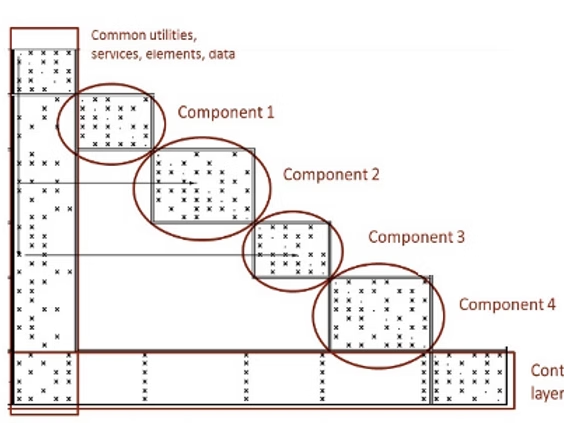
A component may call another component, share data with it, inherit from it, rely on its interface, or include it as part of its operation. Some dependencies are direct; others are indirect, meaning a change can propagate through a chain of connected components.
High coupling does not mean that a system is automatically poorly designed. Some shared capabilities and central services are necessary. The risk emerges when large portions of a system become so interconnected that developers cannot make changes locally or predict the full consequences of a change.
In a loosely coupled, modular system, teams can make changes to one area with limited impact elsewhere. In a tightly coupled system, seemingly small requests can require broad analysis, cross-team coordination, extensive regression testing, and unplanned repair work.
Why coupling creates business risk
The effects of architectural coupling are often first experienced as engineering friction:
- A “small” enhancement takes weeks rather than days.
- Teams hesitate to change critical parts of the system.
- Regression testing expands because the potential blast radius is unclear.
- Defects recur in seemingly unrelated areas.
- Release schedules become harder to predict.
- Developers spend more time understanding dependencies than delivering customer value.
For a business leader, those issues show up differently:
- Slower response to customers and market opportunities
- Higher maintenance and support costs
- Delayed modernization programs
- Greater risk during platform, cloud, security, or integration changes
- Lower developer productivity and morale
- Less confidence in delivery forecasts
This is why architecture is not solely an engineering concern. It is a business capability issue.
Research evidence: highly coupled components cost more to maintain
A 2016 study published in the Journal of Systems and Software examined the relationship between software architecture and maintenance cost in two large systems. The study was co-authored by Alan MacCormack of Harvard Business School and Daniel Sturtevant, co-founders of Silverthread. Each had been in development for more than a decade and contained approximately 20,000 files.
The systems were comparable in age and scale but differed significantly in architecture:
- One had a more hierarchical structure, with a small number of highly central components and relatively loose coupling across the broader system.
- The other had a core-periphery structure, with a much larger group of mutually interdependent core components.
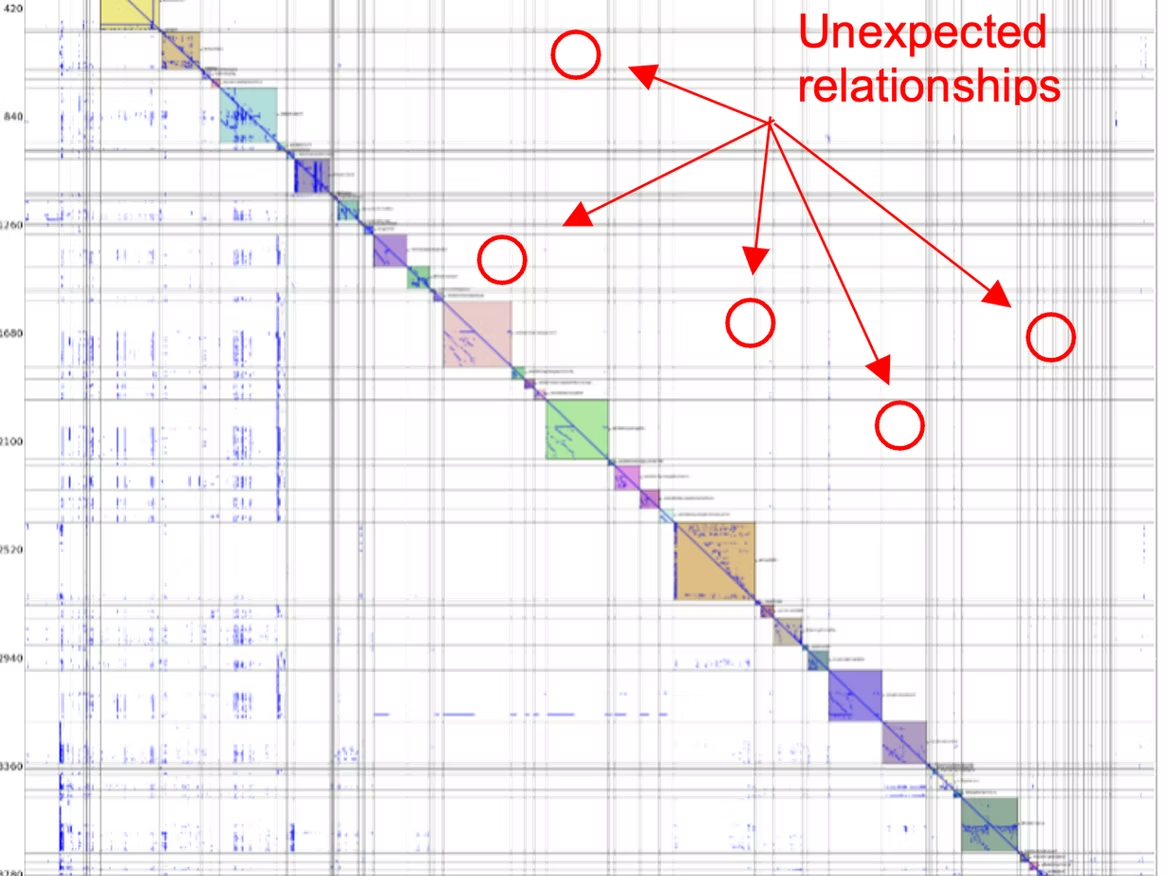
The researchers measured dependencies among software files, including both direct and indirect relationships, then compared those architectural patterns with three years of defect-related maintenance activity.
Their central finding was consistent across both systems: components with higher levels of coupling were more likely to experience defects and generated more maintenance activity than peripheral components.
In the more tightly coupled system:
- Core files made up approximately 26% of the system.
- Those files accounted for 62% of defect-related activity.
- Thirty percent of core files experienced defects during the study period, compared with 5.8% of peripheral files.
The study also found that the more tightly coupled system had substantially higher maintenance cost per line of code than the more hierarchical system.
The important point is not that every central component is bad. It is that architectural structure creates an uneven distribution of risk and cost. A relatively small set of highly interconnected components can create a disproportionate amount of maintenance burden across the software estate.
That conclusion is only useful if an organization can locate its own core. The dependency-classification method used in the study. Extracting direct and indirect relationships among files, then sorting them into core and peripheral roles is the same method Silverthread built into CodeMRI®. It measures the architectural core of a production codebase, sizes it as a percentage of the system, and identifies the cyclic dependency groups that hold it together. Knowing that core files drive most defect activity is a research finding. Knowing which of your files are core is a modernization plan.
Why traditional technical-debt measures are incomplete
Many organizations assess technical debt through code-level indicators:
- Lines of code
- Cyclomatic complexity
- Code smells
- Test coverage
- Static-analysis rule violations
- Framework or library currency
These measures are useful, but they do not fully answer an architectural question: How will a change propagate through the system?
A file can be relatively small and clean yet sit at the center of a large dependency network. Conversely, a complex file that is isolated from the rest of the system may carry less systemic risk.
Effective architectural analysis therefore considers both the condition of individual components and their position within the larger dependency structure.
The AI-assisted development question
AI coding tools can help teams produce and modify software faster. That is real value.
But increased code velocity is not, by itself, evidence of better system health.
If AI-assisted development increases the number of changes flowing into a tightly coupled architecture, it may also increase the likelihood of unintended interactions, testing burden, defect remediation, and future modernization cost. The issue is not whether code was written by a person or generated with AI assistance. The issue is whether the organization can understand the architectural consequences of each change.
Technology leaders need a way to answer questions such as:
- Are we delivering changes faster without increasing architectural complexity?
- Which parts of the system create the greatest risk when changed?
- Where are dependencies making modernization slower and more expensive?
- Are our engineering investments reducing future cost—or simply accelerating today’s output?
- Which refactoring initiatives will create meaningful value?
Without that visibility, organizations tend to rely on lagging indicators: missed release dates, escalating defects, mounting maintenance work, developer frustration, and recurring warnings that a part of the system is “too risky to touch.”
How should leaders prioritize architectural technical debt?
The answer is not a wholesale rewrite.
Large, mature systems usually cannot pause feature delivery while they are rebuilt. Full rewrites are expensive, disruptive, and difficult to justify when the outcome is uncertain.
A more practical approach is targeted, incremental modernization:
- Map the system’s dependencies. Identify direct and indirect relationships among components, not just code-level quality issues.
- Identify architectural hotspots. Look for highly coupled core areas, cyclic dependencies, and components with a large potential change impact.
- Connect architecture to operational outcomes. Compare hotspots with defect activity, maintenance effort, delivery delays, change failure, and development cost.
- Prioritize high-value interventions. Focus on the areas where reducing coupling will make future changes more local, predictable, and testable.
- Measure progress over time. Architectural improvement is rarely a one-time event. Leaders need evidence that modernization work is reducing risk and improving the system’s ability to evolve.
This creates a more disciplined modernization strategy. Instead of asking engineering teams to reduce an abstract debt backlog, organizations can direct investment toward the architectural constraints that most affect delivery, resilience, and cost.
Frequently asked questions
Is architectural technical debt the same as poor code quality?
No. Poor code quality can contribute to technical debt, but architectural technical debt concerns the structure and dependencies of the system as a whole. Clean code can still exist within an architecture that is difficult and risky to change.
Does high coupling always mean a component should be refactored?
No. Some central components are necessary by design. High coupling is a signal to investigate—not an automatic instruction to rewrite. The decision should consider the component’s business importance, defect history, change frequency, maintenance cost, and the feasibility of reducing dependency risk.
Can organizations measure architectural technical debt objectively?
Yes. Dependency analysis can reveal how components are connected, identify tightly coupled areas, and show how changes may propagate through a system. When combined with operational data—such as defects, maintenance effort, delivery time, and cost—it provides an evidence base for modernization decisions. Silverthread's CodeMRI® applies this analysis to production codebases.
Does AI-generated code create technical debt?
AI doesn’t create technical debt. It changes the speed at which technical debt can accumulate. AI can generate code faster than organizations can understand its architectural impact. A change may be perfectly valid in isolation while increasing coupling, dependency risk, or structural complexity across the system. As AI accelerates software development, architectural visibility becomes a critical control: teams need to understand not just whether generated code works, but what it does to the system as a whole.
Is a full rewrite the best way to address architectural debt?
Usually not. For mature systems, targeted and incremental refactoring is typically more practical. The goal is to reduce coupling and improve modularity in the areas where architectural constraints create the greatest business impact.
The leadership opportunity
Every long-lived software system carries some degree of technical debt. The leadership question is not whether it exists. The question is whether the organization can see where architectural complexity is constraining delivery and make informed choices about what to address first.
When architecture becomes visible and measurable, modernization stops being an open-ended engineering expense. It becomes a business investment in speed, resilience, and the organization’s ability to change.
Silverthread helps organizations understand the architecture of complex software systems, identify structural risk, and prioritize modernization efforts based on objective evidence. CodeMRI®, Silverthread's software intelligence platform, applies the dependency-based measurement approach developed in the research cited here making architectural health visible in large production codebases.
Source
MacCormack, A. and Sturtevant, D. “Technical Debt and System Architecture: The Impact of Coupling on Defect-Related Activity.” Journal of Systems and Software (2016). https://doi.org/10.1016/j.jss.2016.06.007
Stay Ahead with Recent Insights
Explore our latest research, case studies, and articles to keep your software strategy sharp.



.avif)





.avif)
Ready to Discuss Your Software Goals?
Let’s talk about your systems. Schedule a tailored strategy session to align modernization efforts with business outcomes and move forward with clarity.