
Is AI-Assisted Development Improving Your Software, or Just Producing More of It?


Is AI-Assisted Development Improving Your Software, or Just Producing More of It?
Key takeaways
- AI coding tools can help teams create and modify software faster, but faster code production is not the same thing as a healthier or more maintainable system.
- The real question is whether AI-assisted changes are improving the software’s ability to evolve or adding complexity that will surface later as defects, rework, and delivery drag.
- Code review, testing, and developer judgment remain essential, but they do not give most organizations a system-level view of how changes are affecting architecture over time.
- Leaders need a baseline and repeatable measurement if they want to know whether AI is creating durable capacity or simply accelerating the accumulation of technical debt.
The conversation about AI-assisted software development is usually framed around speed. Can developers write code faster? Can they complete more work in the same amount of time? Can teams reduce the repetitive work involved in maintaining and changing software?
Those are reasonable questions. AI tools can help generate code, explain unfamiliar code, create tests, suggest fixes, and reduce some of the friction involved in making a change. For many teams, that will create real value.
But speed is only one part of the picture. A company can produce more code, move more tickets, and ship more frequently while making its software harder to change. If AI is adding to an already complicated system without clear architectural guardrails, the cost may not be visible immediately. The application still works. The feature gets released. The team has a productive quarter.
Then the next change takes longer than expected. A defect appears somewhere that seems unrelated to the original work. A modernization effort uncovers dependencies nobody knew existed. Or the team finds itself testing more broadly because it no longer has confidence that a change will remain contained.
The question is not whether AI can help teams create software faster. It can. The question is whether the organization knows what that faster change is doing to the software it will have to maintain next year.
More code is not necessarily more progress
Software organizations have always had to make tradeoffs between moving quickly today and keeping a system understandable tomorrow. AI does not create that tradeoff. It makes it easier to move faster inside it.
That can be a very good thing when the work is well understood and the system has clear boundaries. A developer can use AI to accelerate a contained change, test it, review it, and move on. The organization gets the immediate benefit of faster delivery without creating a disproportionate amount of future work.
The risk is different when the system is already tightly coupled or poorly understood. In that environment, a seemingly small change can interact with services, data, libraries, and business rules outside the original scope. AI can make it quicker to produce the change, but it cannot automatically tell the organization whether that change is increasing coupling, bypassing an intended interface, duplicating logic that already exists elsewhere, or adding to a part of the system that is already too difficult to change. That is not a criticism of the tool. It is simply the nature of the problem.
AI can generate code based on the context it is given. It does not replace the need to understand the larger architecture of a mature application that has evolved over years, teams, acquisitions, product changes, and technology decisions. Code review remains necessary. Testing remains necessary. But neither activity necessarily shows how the accumulated effect of hundreds or thousands of AI-assisted changes is altering the health of the system as a whole.
The question is not whether AI can help teams create software faster. It can. The question is whether the organization knows what that faster change is doing to the software it will have to maintain next year.
The risk does not arrive all at once
This is the part of the AI conversation that can be easy to miss because the immediate value is real. A development team may use AI successfully for months. It may release more work, reduce cycle times, and feel more productive. Leadership sees better output, which is exactly what it hoped to see. There is no reason to assume those gains are not genuine.
But software architecture is cumulative. A system becomes difficult to change when boundaries weaken gradually. One shortcut is not usually the issue. One extra dependency is not usually the issue. The problem emerges when those decisions pile up, particularly in the parts of the system that are already shared, highly connected, or poorly understood.
AI can accelerate that accumulation if an organization treats generated code as a local productivity gain rather than part of a larger system. The code may be technically correct. It may pass tests. It may solve the problem in front of the developer. But if it creates one more dependency, one more workaround, or one more path around a clear architectural boundary, the organization has added a small amount of future cost to a system that may already be carrying too much of it.
That does not mean companies should slow down or prohibit the use of AI. It means they should be honest about what they are trying to manage. The goal is not to measure whether developers used AI correctly in every instance. The goal is to understand whether faster development is leaving the software in better condition, worse condition, or roughly the same condition over time.
Organizations looking for evidence in combination
Most companies already have measures that tell them whether development activity has changed. They can see cycle time, deployment frequency, ticket volume, defect volume, incident volume, and the amount of work a team completes in a release. Those measures are useful. They tell the company whether it is moving more work through the delivery process. They do not tell the company whether that work is creating a system that will be easier or harder to change later.
That requires looking at the evidence in combination. If a team is using AI and delivering more quickly, that is a good sign. But leaders should also want to know whether the extra output is creating a growing review and testing burden; whether defects are increasing or becoming harder to isolate; whether small changes are starting to involve more components and more teams; and whether maintenance work is taking a larger share of the team’s time after the initial release.
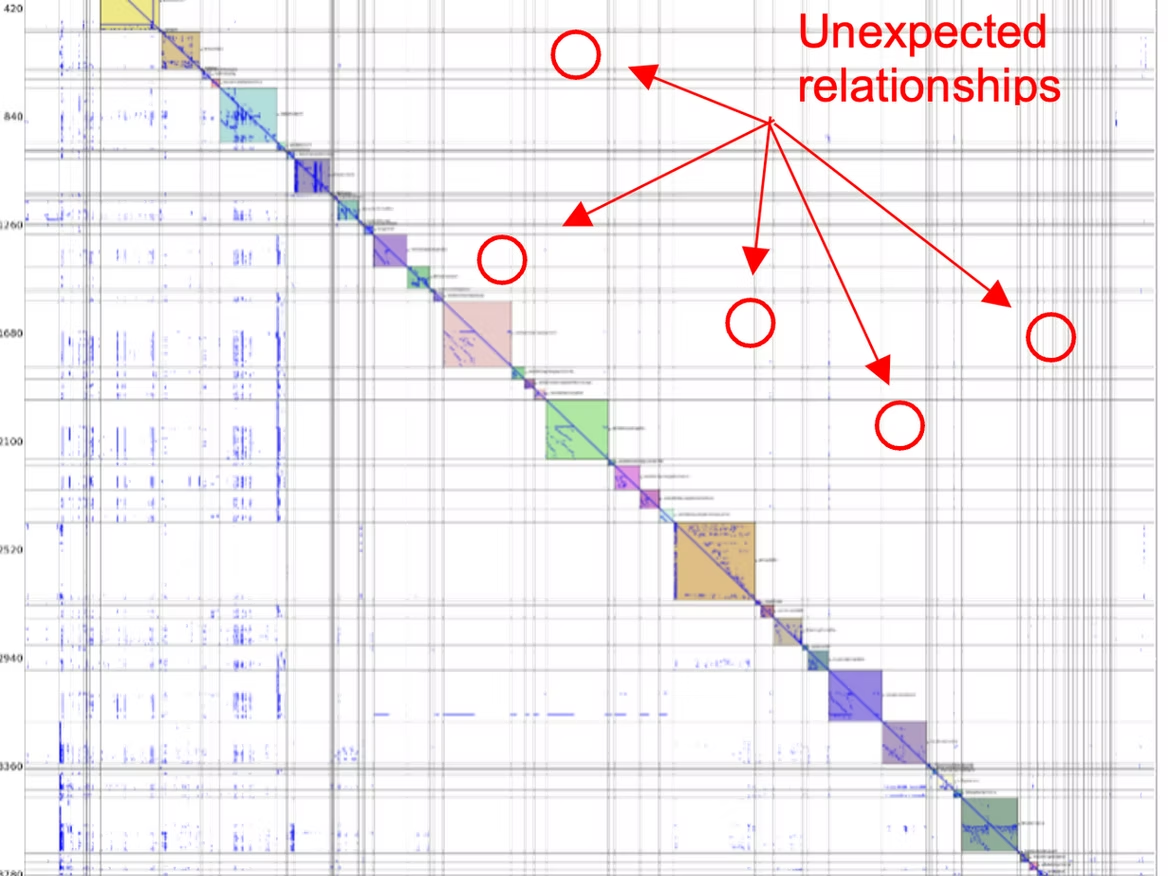
The architecture itself should also be part of the picture. Is the most interconnected part of the system getting larger? Are cyclic dependencies increasing? Is new work respecting the boundaries that allow teams to change software independently, or are those boundaries being bypassed because the fast route was more convenient? Is the organization reducing the number of areas that only a few people understand, or creating more of them?
None of these measures should be read in isolation. A short-term increase in defects, for example, may reflect a team finally addressing a difficult part of the codebase rather than making it worse. A release may require more testing because it is genuinely more significant. The point is not to create a new scorecard that punishes teams for using AI or making hard changes. The point is to give the organization a way to see whether the benefits of AI-assisted development are holding up over time.
If delivery speed improves and the system remains stable, understandable, and manageable, that is a meaningful gain. If delivery speed improves while dependency risk, maintenance burden, defects, and coordination cost all rise, the company may be moving future cost into a later quarter and calling it productivity.
Plenty of companies will adopt AI coding tools. The ones that create a genuine advantage will be able to use the added speed without quietly making their software harder to maintain, modernize, and trust.
A baseline changes the conversation
Most organizations do not have a system-level baseline for this. They may know which teams are experimenting with AI and which tools they are using. They may have policies on security, approved tools, and code review. Those are all important. Without a baseline, however, it is difficult to know whether the condition of a critical system is improving or degrading as development accelerates.
A baseline shows the current state of the architecture before AI-assisted development becomes widespread across a codebase. It can show where dependencies are concentrated, where highly interconnected components create broad change impact, and where the system may already be carrying more structural complexity than teams can comfortably manage.
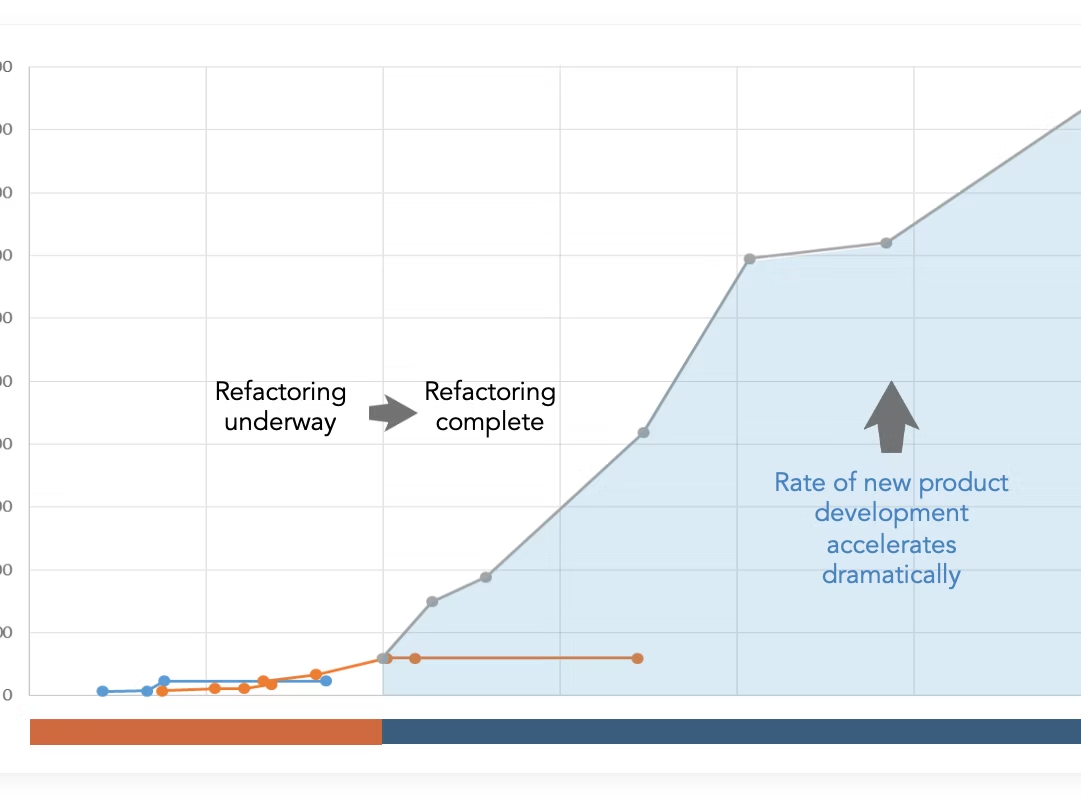
That gives the organization something more useful than a debate about whether AI is good or bad. It creates a fact base. Teams can continue using AI where it is helping. Leaders can see which areas of a system are relatively safe for rapid change and which need more care. Over time, the organization can measure whether AI-assisted development is reducing architectural drag, holding it steady, or making the next modernization decision more difficult.
This is useful for engineering, but it is not only an engineering conversation. A CTO needs to know whether AI is creating more capacity for product delivery. A CIO needs to understand whether faster development is increasing future operational and modernization risk. A CEO and CFO need to know whether investment in AI is producing a durable advantage or simply moving cost into a future budget.
No “go slow” or AI is a threat
The answer is not to treat AI as a threat or to make every code change subject to a new layer of bureaucracy. That would miss the value of the technology and create exactly the sort of friction organizations are trying to reduce.
The answer is to use AI with the same discipline companies should apply to any significant change in how software is created. Establish a baseline. Understand where rapid change is relatively safe and where it requires more architectural care. Give teams clear expectations about the system they are building, not just the code they are producing. Then measure whether the organization is getting what it wants from AI: faster delivery without a corresponding increase in future cost and risk.
Plenty of companies will adopt AI coding tools. The ones that create a genuine advantage will be able to use the added speed without quietly making their software harder to maintain, modernize, and trust.
Silverthread helps technology leaders assess how AI-assisted development is affecting software architecture over time, so they can gain the benefits of faster change without losing sight of system health, technical debt, and future delivery risk. For more information visit us at https://www.silverthreadinc.com/contact-us.
Frequently asked questions
Does AI-generated code automatically create technical debt?
No. AI-generated code is not inherently poor code, and AI can be useful for many development tasks. The concern is that faster change can compound existing architectural problems if an organization cannot see how changes are affecting dependencies, modularity, and the overall health of the system.
Can code review and testing manage AI-assisted development risk?
They are essential, but they focus primarily on individual changes. Code review and testing do not always show how a series of changes is affecting the architecture of a large system over time, particularly where dependencies are indirect or spread across different teams and components.
What should leaders measure when adopting AI coding tools?
In addition to cycle time, deployment frequency, defect activity, and release volume, leaders should understand whether software is becoming easier or harder to change. That includes dependency risk, highly interconnected areas of the system, modularity, the scope of changes, and the amount of review, testing, and maintenance work required to support delivery.
Should companies limit where developers can use AI?
Companies should establish appropriate security, governance, and engineering standards for their environment. From an architectural standpoint, it is especially important to understand which areas of a system are well bounded and which areas are already complex enough that faster change requires additional care.
How can a company tell whether AI is improving software health?
It needs a baseline and a way to measure change over time. If teams are delivering faster while structural complexity, dependency risk, defects, and maintenance burden remain stable or improve, AI may be creating durable capacity. If those conditions are getting worse, the organization may be accelerating future cost rather than reducing it.
Stay Ahead with Recent Insights
Explore our latest research, case studies, and articles to keep your software strategy sharp.








Ready to Discuss Your Software Goals?
Let’s talk about your systems. Schedule a tailored strategy session to align modernization efforts with business outcomes and move forward with clarity.